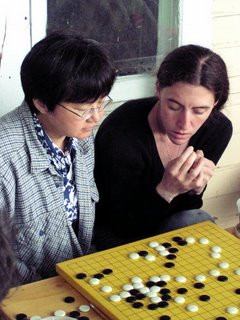
Thesis: defended.
(more later, heading to the pub)
Showing posts with label Maths. Show all posts
Showing posts with label Maths. Show all posts
Tuesday, August 04, 2009

Friday, July 03, 2009
At long last...
Thesis: submitted.
Yesterday I dropped it off at the binders just in time to go see Romeo & Juliet at the Globe, which was wonderful. This afternoon I picked it up from the binders and dropped it off at the College Examinations Office. They promptly dispatched it to my examiners. (There is a rule, about which the college is emphatic, that I am not allowed to send my thesis directly to my examiners. I have no idea why, but apparently it's important.) Now my supervisor will schedule my viva which has to be at least a month (and no more than three months) from today. Meanwhile just about everyone (in number theory) is at Park City, except for me.
Right now it's time for a deep breath and some Belgian beer.
Yesterday I dropped it off at the binders just in time to go see Romeo & Juliet at the Globe, which was wonderful. This afternoon I picked it up from the binders and dropped it off at the College Examinations Office. They promptly dispatched it to my examiners. (There is a rule, about which the college is emphatic, that I am not allowed to send my thesis directly to my examiners. I have no idea why, but apparently it's important.) Now my supervisor will schedule my viva which has to be at least a month (and no more than three months) from today. Meanwhile just about everyone (in number theory) is at Park City, except for me.
Right now it's time for a deep breath and some Belgian beer.
Wednesday, May 06, 2009
FLT
Today I received my first email from someone claiming to have a short proof of Fermat's Last Theorem. They even forwarded someone else's rejection of their argument, which points out their basic misunderstanding of factorisation.
Maybe it's urban legend, but I heard at some point that Cambridge had hired someone full time to respond to such letters. A friend of mine here at King's (who has been teaching the Elementary Number Theory course here for the past few years and is listed on the website as the instructor) recently received a whole book (self-published) with elementary "proofs" of all the major problems in number theory.
Maybe it's urban legend, but I heard at some point that Cambridge had hired someone full time to respond to such letters. A friend of mine here at King's (who has been teaching the Elementary Number Theory course here for the past few years and is listed on the website as the instructor) recently received a whole book (self-published) with elementary "proofs" of all the major problems in number theory.
Friday, April 17, 2009
Hold on to your room, Mark!
Pinball machines, beware!
I'm bound for Ithaca.
I have accepted a one-year visiting position at Cornell, starting this fall. (The Brits always snicker when I say "fall", meaning autumn. I'm happy to take on their plural "maths" and their old school "trousers" and even, eventually, their foreshortened "veg", but using autumn in this context as an American makes me feel pretentious.)
The offer is conditional on one small minor little trifling detail (having my PhD), so I'm a bit busy at the moment.
I'm bound for Ithaca.
I have accepted a one-year visiting position at Cornell, starting this fall. (The Brits always snicker when I say "fall", meaning autumn. I'm happy to take on their plural "maths" and their old school "trousers" and even, eventually, their foreshortened "veg", but using autumn in this context as an American makes me feel pretentious.)
The offer is conditional on one small minor little trifling detail (having my PhD), so I'm a bit busy at the moment.
Ithaca
Constantine P Cavafy
When you set out for Ithaka
ask that your way be long,
full of adventure, full of instruction.
The Laistrygonians and the Cyclops,
angry Poseidon - do not fear them:
such as these you will never find
as long as your thought is lofty, as long as a rare
emotion touch your spirit and your body.
The Laistrygonians and the Cyclops,
angry Poseidon - you will not meet them
unless you carry them in your soul,
unless your soul raise them up before you.
Ask that your way be long.
At many a Summer dawn to enter
with what gratitude, what joy -
ports seen for the first time;
to stop at Phoenician trading centres,
and to buy good merchandise,
mother of pearl and coral, amber and ebony,
and sensuous perfumes of every kind,
sensuous perfumes as lavishly as you can;
to visit many Egyptian cities,
to gather stores of knowledge from the learned.
Have Ithaka always in your mind.
Your arrival there is what you are destined for.
But don't in the least hurry the journey.
Better it last for years,
so that when you reach the island you are old,
rich with all you have gained on the way,
not expecting Ithaka to give you wealth.
Ithaka gave you a splendid journey.
Without her you would not have set out.
She hasn't anything else to give you.
And if you find her poor, Ithaka hasn't deceived you.
So wise you have become, of such experience,
that already you'll have understood what these Ithakas mean.
Wednesday, September 17, 2008
Data!
I think (fingers crossed) that I've finally got my code working properly for higher weights. Theoretically it should work for any prime (at least odd primes) and any level, but it gets slow when the levels start getting bigger (I haven't tested for many primes yet). Right now, it only works for Q(i), though it's just a matter of putting the time in to at least get it to work for the same five imaginary quadratic fields for which Cremona originally did computations.


This (assuming I don't have other problems lurking) is huge. It's a massive weight off my shoulders. It gives me confidence about finishing my PhD in the near future (or at all, for that matter) and it gives me a much more solid basis for applying for jobs (which I need to do this fall, i.e. now).
Now I just ("just") need to compute some Galois representations and match 'em up.


This (assuming I don't have other problems lurking) is huge. It's a massive weight off my shoulders. It gives me confidence about finishing my PhD in the near future (or at all, for that matter) and it gives me a much more solid basis for applying for jobs (which I need to do this fall, i.e. now).
Now I just ("just") need to compute some Galois representations and match 'em up.
Friday, July 18, 2008

Thursday, July 03, 2008
False Positive
I woke this morning to a chat from Aftab, wondering whether I had yet seen this. A brief racing of the heart: Could it be? After all this time? After attending so many talks that started with "We tried to prove such and such" and ended with "We found that it's equivalent to the Riemann Hypothesis"? But I know where to check, so the excitement was short lived.
Meanwhile, on my way in to the office today, I recognized for the first time a tattooed Chinese (or Japanese) character. Now that I'm learning Chinese, I always look to see if I know the characters people have tattooed on themselves, but until now I hadn't seen any that I actually know. This isn't so surprising, as the Chinese we learn tends to be practical, and people are unlikely to tattoo "fried rice" or "taxicab" on themselves.
The tattoo in question was on a girl's arm and the character was 生. I'm told that in Japanese this has 8 billion pronunciations and meanings. In Chinese, I know it as "shēng", meaning "to be born; to give birth; life; to grow". It's possible that it was preceded by another character or other characters, covered by her sleeve, giving a more particular meaning (possibly something one is more likely to tattoo upon oneself). The only thing I could think of offhand was 出生,"chū shēng", "to be born", but that seems unlikely. Searching by pinyin, my dictionary also just turned up 畜生, "chù sheng", "domestic animal", which seems even less likely. We learn 生 early on, as part of 生日, "shēng rì", which means "birthday" (日 is "day" or "sun").
Meanwhile, on my way in to the office today, I recognized for the first time a tattooed Chinese (or Japanese) character. Now that I'm learning Chinese, I always look to see if I know the characters people have tattooed on themselves, but until now I hadn't seen any that I actually know. This isn't so surprising, as the Chinese we learn tends to be practical, and people are unlikely to tattoo "fried rice" or "taxicab" on themselves.
The tattoo in question was on a girl's arm and the character was 生. I'm told that in Japanese this has 8 billion pronunciations and meanings. In Chinese, I know it as "shēng", meaning "to be born; to give birth; life; to grow". It's possible that it was preceded by another character or other characters, covered by her sleeve, giving a more particular meaning (possibly something one is more likely to tattoo upon oneself). The only thing I could think of offhand was 出生,"chū shēng", "to be born", but that seems unlikely. Searching by pinyin, my dictionary also just turned up 畜生, "chù sheng", "domestic animal", which seems even less likely. We learn 生 early on, as part of 生日, "shēng rì", which means "birthday" (日 is "day" or "sun").
Saturday, April 05, 2008
Back to Banff!
I've been accepted for the WIN - Women In Numbers workshop at Banff in November. A whole workshop for women in number theory -- I thought I was the only one!
My calendar is filling up with workshops. I'm thinking about registering for the Modular Forms and Arithmetic workshop at MSRI this summer. I've been waitlisted (I was late in submitting my application) for the summer school on p-adic representations of p-adic groups in Paris in July. And I was invited to (and will probably give a talk at) a workshop in Bristol on Computations with Modular Forms in August.
My calendar is filling up with workshops. I'm thinking about registering for the Modular Forms and Arithmetic workshop at MSRI this summer. I've been waitlisted (I was late in submitting my application) for the summer school on p-adic representations of p-adic groups in Paris in July. And I was invited to (and will probably give a talk at) a workshop in Bristol on Computations with Modular Forms in August.
Monday, January 21, 2008
Divisibility tests
One night while I was home over the holidays, I ended up helping Emma with her homework. First some spelling homework and then maths. She was confused about some problems on the distributive property and she also had to draw three rectangles with area 24, without using 1 x 24. She didn't have any sort of systematic method; she just cast about for integers that divide 24. She had come up with 6 x 4 and 3 x 8 but couldn't find a third rectangle. So I taught her about prime numbers and prime factorisation.
Somehow this led us to divisibility tests. She knew the one for 2 (and I assume she knows the similar tests for 5 and 10). Most people know these tests. My dad was making nachos (for some reason we were doing her homework on the kitchen floor) and overheard me teaching her the divisibility test for 4. He got all indignant: "I didn't know that! Why don't they teach us cool things like that in school?" and ran into the other room, from where we heard his shouts to Kathi, "Did you know that?!?"
The divisibility test for 4 has the same justification as the test for 2 (or, for that matter, for 5 or 10). For 2, you can write your (positive, for the sake of argument) lengthy integer as 10X + Y where Y is less than 10 (and greater than or equal to 0). Then, if Y is divisible by 2 (so Y = 2Y') we have
10X + Y = 2(5X) + 2Y' = 2(5X + Y')
so the big integer is also divisible by 2. (Note that this works because of the distributive property mentioned earlier.) And, likewise, if Y is not even then the big long integer is also not even. For 4, you instead write your integer as 100X + Y, where Y is now less than 100. Since 4 divides 100, you only have to check whether 4 divides Y (so now you have to check whether 4 divides a 2 digit number, which is more work than the even/odd test, but considerably less work than trying to divide 4 into, say, a 7 digit long number).
So Emma tested some big long numbers for divisibility by 4 and after we found a few that were not divisible by 4, I had her come up with a big long number that was divisible by 4. She ended her number with 08, which I liked.
Then I taught her the divisibility test for 3. If you add up the digits of the number and that sum is divisible by 3, then the whole number is divisible by 3. Rather than give a proof, which is much cleaner and nicer if you know about modular arithmetic, I will just give an example. This also uses the distributive property Emma was working on.
635,148 = 6(100,000) + 3(10,000) + 5(1,000) + 1(100) + 4(10) + 8
=6(1+99,999) + 3(1+9,999) + 5(1+999) + 1(1+99) + 4(1+9) + 8
=6+3+5+1+4+8 + 6(99,999) + 3(9,999) + 5(999) + 1(99) + 4(9)
=(6+3+5+1+4+8) + 3[6(33,333) + 3(3,333) + 5(333) + 1(33) + 4(3)]
So, since the right hand part of the last line (the 3[6(33,333) + 3(3,333) + 5(333) + 1(33) + 4(3)] part) is divisible by 3, that means the whole number is divisible by 3 if and only if the left hand part of the last line (the (6+3+5+1+4+8) part) is also divisible by 3. Since this left hand part is simply the sum of the digits of the number, we get our divisibility test. Of course the same argument works to show that the divisibility by 9 test is analogous: an integer is divisible by 9 if and only if the sum of the digits is divisible by 9.
Somehow this led us to divisibility tests. She knew the one for 2 (and I assume she knows the similar tests for 5 and 10). Most people know these tests. My dad was making nachos (for some reason we were doing her homework on the kitchen floor) and overheard me teaching her the divisibility test for 4. He got all indignant: "I didn't know that! Why don't they teach us cool things like that in school?" and ran into the other room, from where we heard his shouts to Kathi, "Did you know that?!?"
The divisibility test for 4 has the same justification as the test for 2 (or, for that matter, for 5 or 10). For 2, you can write your (positive, for the sake of argument) lengthy integer as 10X + Y where Y is less than 10 (and greater than or equal to 0). Then, if Y is divisible by 2 (so Y = 2Y') we have
so the big integer is also divisible by 2. (Note that this works because of the distributive property mentioned earlier.) And, likewise, if Y is not even then the big long integer is also not even. For 4, you instead write your integer as 100X + Y, where Y is now less than 100. Since 4 divides 100, you only have to check whether 4 divides Y (so now you have to check whether 4 divides a 2 digit number, which is more work than the even/odd test, but considerably less work than trying to divide 4 into, say, a 7 digit long number).
So Emma tested some big long numbers for divisibility by 4 and after we found a few that were not divisible by 4, I had her come up with a big long number that was divisible by 4. She ended her number with 08, which I liked.
Then I taught her the divisibility test for 3. If you add up the digits of the number and that sum is divisible by 3, then the whole number is divisible by 3. Rather than give a proof, which is much cleaner and nicer if you know about modular arithmetic, I will just give an example. This also uses the distributive property Emma was working on.
635,148 = 6(100,000) + 3(10,000) + 5(1,000) + 1(100) + 4(10) + 8
=6(1+99,999) + 3(1+9,999) + 5(1+999) + 1(1+99) + 4(1+9) + 8
=6+3+5+1+4+8 + 6(99,999) + 3(9,999) + 5(999) + 1(99) + 4(9)
=(6+3+5+1+4+8) + 3[6(33,333) + 3(3,333) + 5(333) + 1(33) + 4(3)]
So, since the right hand part of the last line (the 3[6(33,333) + 3(3,333) + 5(333) + 1(33) + 4(3)] part) is divisible by 3, that means the whole number is divisible by 3 if and only if the left hand part of the last line (the (6+3+5+1+4+8) part) is also divisible by 3. Since this left hand part is simply the sum of the digits of the number, we get our divisibility test. Of course the same argument works to show that the divisibility by 9 test is analogous: an integer is divisible by 9 if and only if the sum of the digits is divisible by 9.
Tuesday, December 04, 2007
Cornered
I'm trying to compute the first homology group of upper half space H_3 modulo the action of Γ_0(N) with coefficients in a particular Γ_0(N)-module M. (Here, N is an ideal in the ring of integers of an imaginary quadratic field.) I've been studying Cremona's method, which uses a topological argument and is applied with trivial coefficients. To see the topological argument, he first compactifies the upper half space H_3 by adding points at all the cusps and a point at infinity. This doesn't change the homology, but allows a straightforward tessellation of upper half space, making it easy to see how to compute the homology group.
In my situation, with non-trivial coefficients, I have to compute "homology with local coefficients". There's a nice topological description of this, using a system of local groups, or bundle of groups, which is like a vector bundle, but with groups instead of vector spaces. But with non-trivial coefficients, I can't just attach points at the cusps and compactify that way. It's not good enough. The problem is that we need to be able to identify this covering space (bundle of groups) with H_3* x M modulo the diagonal action of Γ_0(N). But if we take H_3* to be the usual compactification, then (if I understand this correctly) the stabilizers in Γ_0(N) of the cusps may be non-trivial, which means that our resulting covering space will not be identifiable with H_3* x M modulo the diagonal action of Γ_0(N). So instead of adding points at the cusps and infinity, I have to add corners, and these corners will probably each consist of an entire half plane! What will that do to my tessellation?
In my situation, with non-trivial coefficients, I have to compute "homology with local coefficients". There's a nice topological description of this, using a system of local groups, or bundle of groups, which is like a vector bundle, but with groups instead of vector spaces. But with non-trivial coefficients, I can't just attach points at the cusps and compactify that way. It's not good enough. The problem is that we need to be able to identify this covering space (bundle of groups) with H_3* x M modulo the diagonal action of Γ_0(N). But if we take H_3* to be the usual compactification, then (if I understand this correctly) the stabilizers in Γ_0(N) of the cusps may be non-trivial, which means that our resulting covering space will not be identifiable with H_3* x M modulo the diagonal action of Γ_0(N). So instead of adding points at the cusps and infinity, I have to add corners, and these corners will probably each consist of an entire half plane! What will that do to my tessellation?
Tuesday, November 20, 2007
Physics is Solved.
Last Friday, Peter (who did his PhD in maths (analysis) at King's and is now working in The City), having joined us at the pub, sat down and promptly informed us, much to the dismay of the theoretical physicists present, that "physics is solved." He had found this article and the paper on the arXiv to which it referred. Peter's claim was intended as mockery of the grandiose title of the paper, "An Exceptionally Simple Theory of Everything" but of course it's difficult to mock such a title with exaggeration.
I don't know much of anything about physics, but Not Even Wrong explains a bit more of what Lisi did (and did not) do, and gives references to some other commentary as well, leading to this pretty picture.
I don't know much of anything about physics, but Not Even Wrong explains a bit more of what Lisi did (and did not) do, and gives references to some other commentary as well, leading to this pretty picture.
Monday, September 24, 2007
Shimura-Taniyama-Weil Conjecture
There's an excellent article by Henri Darmon which was published in 1999 in the Notices of the American Mathematical Society. The article reports the announcement of the proof of the full Shimura-Taniyama-Weil conjecture, but I post it here because it is an excellent overview of the sort of mathematics I am studying. ("Diamond" in the article is my supervisor, Fred Diamond.) I think it's quite readable, though that may just be because I have been studying these things for years.
My work concerns Serre's conjecture, which isn't mentioned explicitly in the article, but is what he's referring to when he talks about establishing connections between automorphic forms and Galois representations (in the Langlands Program section). Basically, the idea is that the Galois representations also have a sequence of numbers associated to them, and you want to be able to determine precisely for which Galois representations there exists a modular form such that the sequence of numbers Darmon describes for the modular form matches the sequence associated to the given Galois representation.
The proof of Serre's original conjecture is pretty much complete by now. Here's a layman's notice from 2005 on Khare's proof. My thesis will (hopefully) be a formulation of the conjecture (in particular, the so-called "weight part" of the conjecture) over imaginary quadratic fields along the lines of the formulation over totally real fields by my supervisor and two others (at conferences I've heard it referred to as the "BDJ conjecture" and the "Buzzard-Diamond-Jarvis paper" even though it hasn't actually been published yet), and then to also provide some evidence that the conjecture is the correct one.
My work concerns Serre's conjecture, which isn't mentioned explicitly in the article, but is what he's referring to when he talks about establishing connections between automorphic forms and Galois representations (in the Langlands Program section). Basically, the idea is that the Galois representations also have a sequence of numbers associated to them, and you want to be able to determine precisely for which Galois representations there exists a modular form such that the sequence of numbers Darmon describes for the modular form matches the sequence associated to the given Galois representation.
The proof of Serre's original conjecture is pretty much complete by now. Here's a layman's notice from 2005 on Khare's proof. My thesis will (hopefully) be a formulation of the conjecture (in particular, the so-called "weight part" of the conjecture) over imaginary quadratic fields along the lines of the formulation over totally real fields by my supervisor and two others (at conferences I've heard it referred to as the "BDJ conjecture" and the "Buzzard-Diamond-Jarvis paper" even though it hasn't actually been published yet), and then to also provide some evidence that the conjecture is the correct one.
Tuesday, August 07, 2007
Progress?
I just need some place
where I can lay my head
"The Weight"
J. R. Robertson
It looks like I finally got my program to work for Gamma_1(N). Of course, there's still so much to do. I need to:
- implement characters other than the trivial one
- modify it to work over \bar{\FF_{\ell}} instead of \CC
- finish implementing support for Gamma_1(N) intersect Gamma(p)
- maybe someday make it work for imaginary quadratic fields other than \QQ(i)
That's just for my code. Then I need to go back to actually formulating this conjecture and I also need to come up with Galois representations corresponding to the modular forms I will hopefully find.
Sunday, July 08, 2007
Mathematical Personality Test
 | If I were a Springer-Verlag Graduate Text in Mathematics, I would be Joe Harris's Algebraic Geometry: A First Course. I am intended to introduce students to algebraic geometry; to give them a sense of the basic objects considered, the questions asked about them, and the sort of answers one can expect to obtain. I thus emphasize the classical roots of the subject. For readers interested in simply seeing what the subject is about, I avoid the more technical details better treated with the most recent methods. For readers interested in pursuing the subject further, I will provide a basis for understanding the developments of the last half century, which have put the subject on a radically new footing. Based on lectures given at Brown and Harvard Universities, I retain the informal style of the lectures and stresses examples throughout; the theory is developed as needed. My first part is concerned with introducing basic varieties and constructions; I describe, for example, affine and projective varieties, regular and rational maps, and particular classes of varieties such as determinantal varieties and algebraic groups. My second part discusses attributes of varieties, including dimension, smoothness, tangent spaces and cones, degree, and parameter and moduli spaces. Which Springer GTM would you be? The Springer GTM Test |
Monday, July 02, 2007
Coincidence
Last night I left my office around 8 pm and was heading home, weaving my way through gawking tourists. Someone ahead, blocking my way to the street crossing, called out to me. I looked up, expecting to provide directions to some landmark or other, but there in front of me stood Baskar and Stefan! Seven and a half million people in this massive sprawling city, and I run into two people I know. I didn't even know they were in London -- they're only here briefly, stopping on their way from Montreal to Coventry or Israel via France and India.
So, naturally (this being England), I turned around and we went to a pub.
So, naturally (this being England), I turned around and we went to a pub.
Tuesday, June 12, 2007
Banff
I'm back in London now, and very much jetlagged. I slept for 12 hours last night, but I've been really dizzy all morning.
My weekend in Banff after the workshop was very nice. On Saturday, I followed the example of two other workshop participants who were staying around a bit longer, and joined the Grand Nature hiking club on a trip to Castle Lookout. The scheduled trip was for Lake Louise, but the organizer said that there were avalanche warnings. There are a few photos from our trip on the Grand Nature club website.
On Sunday, my shuttle to the airport didn't depart until 5:30 p.m., so I had some time to get in one last hike before I left. In spite of the fact that a gondola carries loads of tourists to the top, I hiked up Sulphur Mountain. It was a really nice hike and would have been perfect if it weren't for the crowds at the peak. There were nice views all the way up, but when you get to the top, the view of the other side is really spectacular. I've put photos up here.
I've stolen a couple of pictures from Ken Ribet. Here I am with (left to right) Armand Brumer, Karen Taylor and Ken Ribet:

And here's one of Karen and me:

My weekend in Banff after the workshop was very nice. On Saturday, I followed the example of two other workshop participants who were staying around a bit longer, and joined the Grand Nature hiking club on a trip to Castle Lookout. The scheduled trip was for Lake Louise, but the organizer said that there were avalanche warnings. There are a few photos from our trip on the Grand Nature club website.
On Sunday, my shuttle to the airport didn't depart until 5:30 p.m., so I had some time to get in one last hike before I left. In spite of the fact that a gondola carries loads of tourists to the top, I hiked up Sulphur Mountain. It was a really nice hike and would have been perfect if it weren't for the crowds at the peak. There were nice views all the way up, but when you get to the top, the view of the other side is really spectacular. I've put photos up here.
I've stolen a couple of pictures from Ken Ribet. Here I am with (left to right) Armand Brumer, Karen Taylor and Ken Ribet:

And here's one of Karen and me:

Friday, June 08, 2007
Banff
 This morning I hiked Tunnel Mountain once again after breakfast. I would go before breakfast, but the meals are so large and close together, that I like to separate them as much as possible.
 While hurrying back down the mountain to make it in time for the first talk, I came to a sudden halt. There were about six elk on the path.
  I snapped some photos and waited for them to meander away a bit before walking past. I just barely got to the talk in time.
  This is Bjorn Poonen from U.C. Berkeley. The photo is here for Kate's sake: some of the speakers do use slightly more technologically advanced equipment. Most just use the blackboard. A few do, in fact, use the old school projector.
Banff
 Yesterday I hiked up Tunnel Mountain twice. In the morning I went solo after breakfast (as I will do again today) and in the afternoon I went with a few other mathematicians, since we had the afternoon off. I didn't bother to bring my camera in the afternoon, but it turns out that I should have. In the afternoon the skies were clear and there were whole new views that I hadn't seen before. These photos are from my misty morning climb.
 Today is the last day of the workshop, which ends with lunch. Then I have to move my stuff over to a hostel in town, so I'm not sure what my internet access will be like for the weekend. I'm here until Sunday. I'm hoping to get in a more significant hike Saturday morning and then find a cafe in which to work Saturday afternoon. Hopefully I can get in a minor hike Sunday morning before leaving as well.
  I think having workshops like this, where everyone is forced to spend time together, is a really good idea. Mathematicians in particular are notoriously reticent, but when, day after day, meal after meal, you're forced to sit next to each other, you eventually get to know each other a bit. It makes a huge difference. Last night, in the lounge, a lot of people were around, socializing, of all things! Some people were playing bridge, some were half watching a basketball game and many were having a beer and chatting, only occasionally about mathematics.
Wednesday, June 06, 2007
Banff
 It's not all trees, mountains and fresh air. Here's Noam Elkies from Harvard University.
 And Henri Darmon from McGill University.
Our free afternoon got pushed back to tomorrow, because of all the rain today. We've got a packed schedule (4 talks) this afternoon. I snuck in a quick walk with Karen, who is at Nottingham now, after lunch. There are four of us girls here, out of about 40 participants, which we all agreed was not bad at all.
Tuesday, June 05, 2007
Banff
 Yesterday morning, the Banff International Research Station (BIRS) station manager welcomed us to the Banff Research Center with a short introductory talk. She told us to watch out for bears and ticks and to drink a lot of water. I think some of the mathematicians were a bit intimidated.
  Before breakfast this morning, my friend Jen and I hiked up Tunnel Mountain, which is the Inspiration Point of Banff. It was easy, but beautiful and a great way to start the day.
  Tomorrow we have a free afternoon, but the forecast is for lots of rain. Of course, the forecast has been for rain all day every day, and we haven't seen too much yet. I walked by Bow River a bit after dinner last night and as I was heading back, dark ominous clouds were piling up. I didn't actually get caught out in it, which was good, because the one or two drops I felt were the size of golf balls.
Subscribe to:
Posts (Atom)