I'm trying to compute the first homology group of upper half space H_3 modulo the action of Γ_0(N) with coefficients in a particular Γ_0(N)-module M. (Here, N is an ideal in the ring of integers of an imaginary quadratic field.) I've been studying Cremona's method, which uses a topological argument and is applied with trivial coefficients. To see the topological argument, he first compactifies the upper half space H_3 by adding points at all the cusps and a point at infinity. This doesn't change the homology, but allows a straightforward tessellation of upper half space, making it easy to see how to compute the homology group.
In my situation, with non-trivial coefficients, I have to compute "homology with local coefficients". There's a nice topological description of this, using a system of local groups, or bundle of groups, which is like a vector bundle, but with groups instead of vector spaces. But with non-trivial coefficients, I can't just attach points at the cusps and compactify that way. It's not good enough. The problem is that we need to be able to identify this covering space (bundle of groups) with H_3* x M modulo the diagonal action of Γ_0(N). But if we take H_3* to be the usual compactification, then (if I understand this correctly) the stabilizers in Γ_0(N) of the cusps may be non-trivial, which means that our resulting covering space will not be identifiable with H_3* x M modulo the diagonal action of Γ_0(N). So instead of adding points at the cusps and infinity, I have to add corners, and these corners will probably each consist of an entire half plane! What will that do to my tessellation?
skip to main |
skip to sidebar



Books
Riprap
Lay down these words
Before your mind like rocks.
placed solid, by hands
In choice of place, set
Before the body of the mind
in space and time:
Solidity of bark, leaf, or wall
riprap of things:
Cobble of milky way.
straying planets,
These poems, people,
lost ponies with
Dragging saddles –
and rocky sure-foot trails.
The worlds like an endless
four-dimensional
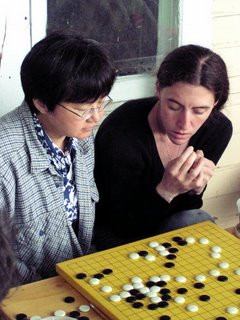
Game of Go.
ants and pebbles
In the thin loam, each rock a word
a creek-washed stone
Granite: ingrained
with torment of fire and weight
Crystal and sediment linked hot
all change, in thoughts,
As well as things.
--Gary Snyder
Before your mind like rocks.
placed solid, by hands
In choice of place, set
Before the body of the mind
in space and time:
Solidity of bark, leaf, or wall
riprap of things:
Cobble of milky way.
straying planets,
These poems, people,
lost ponies with
Dragging saddles –
and rocky sure-foot trails.
The worlds like an endless
four-dimensional
Game of Go.
ants and pebbles
In the thin loam, each rock a word
a creek-washed stone
Granite: ingrained
with torment of fire and weight
Crystal and sediment linked hot
all change, in thoughts,
As well as things.
--Gary Snyder
1 comment:
i hate when my tessellation gets f-ed up.
Post a Comment