Last night I made Kara's Grandma's Apricot Cookies, one of my favourite recipes:
1 c. butter
8 oz pkg neufchatel
2 3/4 c. flour
1/2 c. sugar
apricot preserves
powdered sugar
Mix butter and neufchatel. Add flour and sugar, mix. Form into 8 balls, flatten slightly. Refrigerate for at least 1 hour. Roll into circles (roll in powdered sugar). Cut in 1/8ths. Place small amount of apricot on each piece. Roll up like a croissant. Bake on ungreased cookie sheet at 350 degrees for 15-20 minutes.
Monday, July 30, 2007

Saturday, July 28, 2007
Chengyu (成语)
My friend Chunyan (春燕, which, if I remember correctly, means "Spring Swallow") has recently started a Chinese class. Séverine and I are both taking it, along with Chunyan's supervisor (she's in Computer Science) and a few other people she knows through her department.
I attended for the first time on Thursday evening, having missed the first session the previous week because I was in Paris. Chunyan's supervisor is a total beginner, but everyone else in the class probably knows even more Mandarin than Séverine and I do.
Chunyan is trying to do some different things from the usual basic dialogues so that the rest of us can learn something without leaving her supervisor in the dust. One of the things she's doing is Chengyu (成语), or Chinese proverbs. Each is typically four characters long. Our first one is 拔苗助长, pronounced "bá miáo zhù zhǎng". Translated literally, it means "pull up baby plant help grow up", as in attempting to get your plants to grow faster by pulling them up a tiny bit out of the ground so they look bigger. The moral we were given in English is "too much zeal spoils all".
I attended for the first time on Thursday evening, having missed the first session the previous week because I was in Paris. Chunyan's supervisor is a total beginner, but everyone else in the class probably knows even more Mandarin than Séverine and I do.
Chunyan is trying to do some different things from the usual basic dialogues so that the rest of us can learn something without leaving her supervisor in the dust. One of the things she's doing is Chengyu (成语), or Chinese proverbs. Each is typically four characters long. Our first one is 拔苗助长, pronounced "bá miáo zhù zhǎng". Translated literally, it means "pull up baby plant help grow up", as in attempting to get your plants to grow faster by pulling them up a tiny bit out of the ground so they look bigger. The moral we were given in English is "too much zeal spoils all".
Wednesday, July 25, 2007
Chips and mash
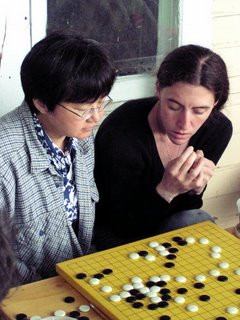
 The fourth in my queue of visitors has just left. Robert was my first (and only?) Go player to visit, so I've been playing some Go for the first time in six months. The last time I saw him he wasn't a Go player and, though I meet new friends through Go, it's something else entirely to have an old friend who can suddenly play with me. Mostly we spent our time playing in pubs or cafes and avoiding eating, which in England can be hazardous. There's a New Yorker article about the British chef Gordon Ramsey with an excellent description of the irony of English cuisine:
...how, for two centuries, has a country with so many resources—creams and butters and handmade cheeses, a practice of grass-feeding sheep and cattle, wild fish, abundant game—produced such a spectacularly loathsome fare? “Try harder than ever for quality,” Elizabeth David wrote in the 1977 edition of “French Provincial Cooking.” “A little fine olive oil, or true, clear stock, or double cream from Jersey herds, or a few fresh eggs laid by decently-fed, humanely-reared hens.” The simple good ingredients were there: why weren’t people using them? Why did they seek out the substandard, the industrial, and the unhealthy: prawn cocktail crisps, say, or fish fingers with Birds Eye peas (a “traditional” Sunday supper), or a “spag bol,” that horrific canned imitation of a classic Bolognese pasta? The implicit complaint—that the English don’t care what they put in their mouths—was evident in how it got there: by scooping up most of what was on your plate and eating it in one bite. Using your knife, you crushed what you could onto the back of your fork, one item after the other, your starches (like that perennial favorite chips and mash), your green-gray veg, a modest protein, calculatedly overcooked, unless it was fish, in which case it was just outright obliterated, and then—bang!—into the mouth, fork upside down. “I really don’t know what English food is,” Ramsay told me. “Spotted dick? Toad-in-the-hole? Curry is the national dish, and people still fry Mars bars for dinner.”
 We spent a few days in Paris (where eating is safe), staying with my friend Aftab from Brandeis. When we got there, we immediately regretted not bringing the Go ban. Without really believing it, I suggested that we might be able to find a shop with Go equipment, as I had a vague memory of seeing something promising the last time I was in Paris. So we wandered around the neighborhood I had stayed in before, near the Sorbonne where we were to meet up with Aftab later anyway. After poking our heads into just a couple of the inexplicably large number of stores devoted exclusively to selling figurines of comic book characters, we figured we must be close. Turning down a small side street, we finally happened upon a shop with chess boards in the window. Their Go related stock was impressive with three shelves of books, including the latest books in English, and a fairly large selection of equipment. Like kids in a candy store we exclaimed and grabbed and darted about. Settling on a mat for a board and some glass stones, we thanked the shopkeeper profusely and headed for a cafe.
Monday, July 09, 2007
Tour de France
 Yesterday I went into work a bit late so I could watch the Tour de France ride by where it crossed my route. Where I went to see them was pretty quiet, with only a few spectators, so it seemed pretty subdued. Also, it was before the official start of Stage 1; they were just cycling through central London to some ceremony at Tower Bridge and then racing for real out to Canterbury. It was fun to see them though, and think about all the work and preparation they put into this event which is now upon them.
  The cyclists, even though not yet racing, were all past in about 30 seconds. Following them was an endless parade of official vehicles, many of which were sprouting bicycle forests from their roofs.
 Ever since I heard that the Tour de France would start in London this year, I had been entertaining this delightful (though not so realistic) image of all the cyclists in their sponsor splattered spandex cycling through London, folding up their Bromptons and hopping on the Eurostar to Paris. Of course, it doesn't work that way and they don't ride Bromptons, at least not in the Tour.
Meanwhile, in Paris they're implementing something a bit like Grandma's bicycle plan for New York.
With the Wimbledon finals also in London this weekend, it was quite a lot of sport for the city. It was unusual also because normally if it's not football (i.e. soccer), rugby or cricket, no one here seems to care.
Sunday, July 08, 2007
Mathematical Personality Test
 | If I were a Springer-Verlag Graduate Text in Mathematics, I would be Joe Harris's Algebraic Geometry: A First Course. I am intended to introduce students to algebraic geometry; to give them a sense of the basic objects considered, the questions asked about them, and the sort of answers one can expect to obtain. I thus emphasize the classical roots of the subject. For readers interested in simply seeing what the subject is about, I avoid the more technical details better treated with the most recent methods. For readers interested in pursuing the subject further, I will provide a basis for understanding the developments of the last half century, which have put the subject on a radically new footing. Based on lectures given at Brown and Harvard Universities, I retain the informal style of the lectures and stresses examples throughout; the theory is developed as needed. My first part is concerned with introducing basic varieties and constructions; I describe, for example, affine and projective varieties, regular and rational maps, and particular classes of varieties such as determinantal varieties and algebraic groups. My second part discusses attributes of varieties, including dimension, smoothness, tangent spaces and cones, degree, and parameter and moduli spaces. Which Springer GTM would you be? The Springer GTM Test |
Monday, July 02, 2007
Coincidence
Last night I left my office around 8 pm and was heading home, weaving my way through gawking tourists. Someone ahead, blocking my way to the street crossing, called out to me. I looked up, expecting to provide directions to some landmark or other, but there in front of me stood Baskar and Stefan! Seven and a half million people in this massive sprawling city, and I run into two people I know. I didn't even know they were in London -- they're only here briefly, stopping on their way from Montreal to Coventry or Israel via France and India.
So, naturally (this being England), I turned around and we went to a pub.
So, naturally (this being England), I turned around and we went to a pub.
Subscribe to:
Posts (Atom)