Showing posts with label Go. Show all posts
Showing posts with label Go. Show all posts
Wednesday, November 19, 2008

Saturday, September 13, 2008
EGC '09
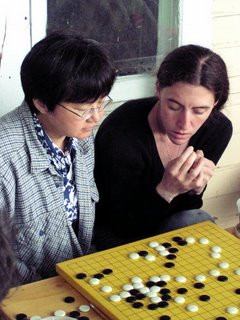
 In the summer of 2009, the European Go Congress will be held in Groningen, The Netherlands. Two years ago, when I was in China studying Go, Walther and I promised Siu (right, with Zhang Pei Pei) we would attend his congress. (Walther and Siu were fellow students of mine in China, and Siu's club is the one hosting the 2009 EGC.)
I've never been to any Go congress (European or U.S. -- are there others?), so it's about time I get to one, huh? I haven't played in ages. Maybe this is a good way to get back in the swing of things. I'll have to finish the thesis first though.
Walther is scheduled to take the NY bar exam the first week of the Congress, but says he should be able to get there for the second week. Siu is trying to get Yan Laoshi (our teacher while we were in Wuhan) to come, but he says it's up to the Wei Qi Centre in Beijing. I assume Guo Juan will be there. Maybe Romain will come too, and we can have a reunion.
Wednesday, July 23, 2008

Sunday, June 29, 2008
Grand Masters Game 6
Monday, May 12, 2008
Miserable excuse for a game record
Since Tanaka-san emailed me personally, I decided to go back and visit the Nippon Club's Saturday Go meeting. Apparently they've combined with the Central London Club, which used to meet on Saturdays up on Great Portland Street. The Nippon Club is in a better location for me.
I played Francis Roads, 3d, taking two stones. Below is my miserable attempt at reproducing the game. I'm rusty.
I'm confident that, with a bit of brushing up, I could easily play him even. Except that I'm so slow. I thought I was playing quickly, finishing the whole game in less than two hours, maybe even closer to an hour and a half (I'm not exactly sure what time we started playing). Still, he spent the game complaining about and mocking my pace. I think he (along with most of the others there) measures his average game in minutes.
I played Francis Roads, 3d, taking two stones. Below is my miserable attempt at reproducing the game. I'm rusty.
I'm confident that, with a bit of brushing up, I could easily play him even. Except that I'm so slow. I thought I was playing quickly, finishing the whole game in less than two hours, maybe even closer to an hour and a half (I'm not exactly sure what time we started playing). Still, he spent the game complaining about and mocking my pace. I think he (along with most of the others there) measures his average game in minutes.
Friday, May 02, 2008
Grand Masters Game 5
I just finished watching Jujo Jiang's audio lecture on this 1954 Jubango game between Go Seigen and Sakata Eio. I love hearing in his voice the delight he takes in reviewing these beautiful old games.
Sunday, March 23, 2008
Null and void
Vows to not play until one's thesis is finished are null and void when there's a 6 dan in town, right?
Sunday, March 09, 2008

Tuesday, December 18, 2007
BCS
Though I'm still not playing any Go these days, I am working again on Basic Corner Shapes via Cho Chikun's life and death dictionary. This one (white to play) is one of my favourites:

Here's a poem by Sylvia Plath to knock the answer off the page and out of sight. (So read the problem before the poem.)
Mushrooms
"Overnight, very
Whitely, discreetly,
Very quietly
Our toes, our noses
Take hold on the loam,
Acquire the air.
Nobody sees us,
Stops us, betrays us;
The small grains make room.
Soft fists insist on
Heaving the needles,
The leafy bedding,
Even the paving.
Our hammers, our rams,
Earless and eyeless,
Perfectly voiceless,
Widen the crannies,
Shoulder through holes. We
Diet on water,
On crumbs of shadow,
Bland-mannered, asking
Little or nothing.
So many of us!
So many of us!
We are shelves, we are
Tables, we are meek,
We are edible,
Nudgers and shovers
In spite of ourselves.
Our kind multiplies:
We shall by morning
Inherit the earth.
Our foot's in the door."
This is only one variation. White 1 is the proper first move, but then there are a number of things Black might try (none of which work). I particularly like this sequence though — an elegant little kill.


Here's a poem by Sylvia Plath to knock the answer off the page and out of sight. (So read the problem before the poem.)
Mushrooms
"Overnight, very
Whitely, discreetly,
Very quietly
Our toes, our noses
Take hold on the loam,
Acquire the air.
Nobody sees us,
Stops us, betrays us;
The small grains make room.
Soft fists insist on
Heaving the needles,
The leafy bedding,
Even the paving.
Our hammers, our rams,
Earless and eyeless,
Perfectly voiceless,
Widen the crannies,
Shoulder through holes. We
Diet on water,
On crumbs of shadow,
Bland-mannered, asking
Little or nothing.
So many of us!
So many of us!
We are shelves, we are
Tables, we are meek,
We are edible,
Nudgers and shovers
In spite of ourselves.
Our kind multiplies:
We shall by morning
Inherit the earth.
Our foot's in the door."
This is only one variation. White 1 is the proper first move, but then there are a number of things Black might try (none of which work). I particularly like this sequence though — an elegant little kill.

Monday, November 19, 2007
Guo Juan visits London!
 I had lunch with Guo Juan and her friend Bob this afternoon. They're in London on holiday this week. It's always great to see Guo Juan.
 She took us to a restaurant in Chinatown which she says is famous for having good cheap food and awful service. I didn't notice the service being so terrible, but then Guo Juan just ordered for us quickly in Chinese. We didn't even look at the menu. It was certainly good, and unbelievably cheap.
They were supposed to join me for the Royal Opera House lunchtime recital today, but unfortunately it was cancelled. Apparently the singer was ill, which is no surprise given the cold, wet, windy, dark and generally miserable weather we've had lately. Last night my umbrella broke while I was walking home. Fortunately, one can buy an umbrella anywhere in London, including any post office. Of course I haven't bought a new one yet. I just walk around with one side of the umbrella flopping down. I'll have to give in soon though, as the weather is unlikely to change.
Guo Juan asked me if I know Pierre Colmez, who is an excellent number theorist in France. He's also a very good Go player, at French 5 or 6 dan. I certainly know of him, and I've seen him give talks, but I've never actually met him. Go players always ask me if I know him, because he is a mathematician and mathematicians always ask me if I know him, because he is a Go player. I'm afraid I'll have to get much better at both before anyone asks him whether he knows me.
Tuesday, September 25, 2007

Wednesday, July 25, 2007
Chips and mash
 The fourth in my queue of visitors has just left. Robert was my first (and only?) Go player to visit, so I've been playing some Go for the first time in six months. The last time I saw him he wasn't a Go player and, though I meet new friends through Go, it's something else entirely to have an old friend who can suddenly play with me. Mostly we spent our time playing in pubs or cafes and avoiding eating, which in England can be hazardous. There's a New Yorker article about the British chef Gordon Ramsey with an excellent description of the irony of English cuisine:
...how, for two centuries, has a country with so many resources—creams and butters and handmade cheeses, a practice of grass-feeding sheep and cattle, wild fish, abundant game—produced such a spectacularly loathsome fare? “Try harder than ever for quality,” Elizabeth David wrote in the 1977 edition of “French Provincial Cooking.” “A little fine olive oil, or true, clear stock, or double cream from Jersey herds, or a few fresh eggs laid by decently-fed, humanely-reared hens.” The simple good ingredients were there: why weren’t people using them? Why did they seek out the substandard, the industrial, and the unhealthy: prawn cocktail crisps, say, or fish fingers with Birds Eye peas (a “traditional” Sunday supper), or a “spag bol,” that horrific canned imitation of a classic Bolognese pasta? The implicit complaint—that the English don’t care what they put in their mouths—was evident in how it got there: by scooping up most of what was on your plate and eating it in one bite. Using your knife, you crushed what you could onto the back of your fork, one item after the other, your starches (like that perennial favorite chips and mash), your green-gray veg, a modest protein, calculatedly overcooked, unless it was fish, in which case it was just outright obliterated, and then—bang!—into the mouth, fork upside down. “I really don’t know what English food is,” Ramsay told me. “Spotted dick? Toad-in-the-hole? Curry is the national dish, and people still fry Mars bars for dinner.”
 We spent a few days in Paris (where eating is safe), staying with my friend Aftab from Brandeis. When we got there, we immediately regretted not bringing the Go ban. Without really believing it, I suggested that we might be able to find a shop with Go equipment, as I had a vague memory of seeing something promising the last time I was in Paris. So we wandered around the neighborhood I had stayed in before, near the Sorbonne where we were to meet up with Aftab later anyway. After poking our heads into just a couple of the inexplicably large number of stores devoted exclusively to selling figurines of comic book characters, we figured we must be close. Turning down a small side street, we finally happened upon a shop with chess boards in the window. Their Go related stock was impressive with three shelves of books, including the latest books in English, and a fairly large selection of equipment. Like kids in a candy store we exclaimed and grabbed and darted about. Settling on a mat for a board and some glass stones, we thanked the shopkeeper profusely and headed for a cafe.
Tuesday, April 03, 2007
Go Seigen vs. Inoue Kohei -- 11/25/1927
My Go is more or less on hold for the moment, as I try to spend all my time on maths in hopes of someday finishing my thesis. I still take a few minutes every day to do some problems and review a pro game though. For the past week or so, instead of looking at a recent game or an old Lee Sedol game, I've been studying this 1927 Go Seigen game.
It is the second game in the "Grand Masters" series on Guo Juan's Audio Lessons site. I love the pro game reviews on her site, but I find that I get a lot more out of them if I memorize the game first. I have this game memorized now, but I'll continue reviewing it every day until I get a chance to watch both of the lectures on it.
These lectures (in the "Grand Masters" series) are done by Jujo Jiang 9p. His style is very different from Guo Juan's, but I really enjoy his lessons as well. Go Seigen's games are beautiful and worth studying in their own right, but one of the things that I especially like about these lectures is that you get to hear stories about the players and the games that, as westerners, we would probably never hear otherwise.
It is the second game in the "Grand Masters" series on Guo Juan's Audio Lessons site. I love the pro game reviews on her site, but I find that I get a lot more out of them if I memorize the game first. I have this game memorized now, but I'll continue reviewing it every day until I get a chance to watch both of the lectures on it.
These lectures (in the "Grand Masters" series) are done by Jujo Jiang 9p. His style is very different from Guo Juan's, but I really enjoy his lessons as well. Go Seigen's games are beautiful and worth studying in their own right, but one of the things that I especially like about these lectures is that you get to hear stories about the players and the games that, as westerners, we would probably never hear otherwise.
Tuesday, March 06, 2007
Embedded games!
This is what I wanted this summer while we were in China! I saw on Karen's blog that she had found an applet to display games in her blog, so that people don't have to download them and open them with a separate sgf editor. Of course, they look much nicer in CGoban, but I guess one can't have everything.
Here's a recent game posted on Go4Go.net:
On Guo Juan's recommendation, I've been studying old Lee Sedol games lately, with the aim of improving my fighting skills. Nowadays, Lee Sedol has calmed down a bit and doesn't aggressively overplay the way he used to. I'm happy to study any games (not just Lee Sedol) with a lot of fighting in them.
Since I have a tendency to be a relatively calm player, I'm interested in how to start fights and also in how to play good shape during the fights. It's also fascinating to see how these guys walk this tightrope, playing chicken. There's a balance to maintain--leaving your weak groups to play bigger points, but coming back just in time (or, if you're off, too late) to save them. One also has to weigh the option of abandoning your weak group to kill (or threaten to kill) something bigger on the other side.
As a smaller side note, I don't understand (in the above embedded game) why White plays moves 168 (B15) and 172 (C13). It seems to me that this is just wasting ko threats, and inciting Black to play moves like 175 (L13) and 177 (N13), which take away White's liberties.
Here's a recent game posted on Go4Go.net:
On Guo Juan's recommendation, I've been studying old Lee Sedol games lately, with the aim of improving my fighting skills. Nowadays, Lee Sedol has calmed down a bit and doesn't aggressively overplay the way he used to. I'm happy to study any games (not just Lee Sedol) with a lot of fighting in them.
Since I have a tendency to be a relatively calm player, I'm interested in how to start fights and also in how to play good shape during the fights. It's also fascinating to see how these guys walk this tightrope, playing chicken. There's a balance to maintain--leaving your weak groups to play bigger points, but coming back just in time (or, if you're off, too late) to save them. One also has to weigh the option of abandoning your weak group to kill (or threaten to kill) something bigger on the other side.
As a smaller side note, I don't understand (in the above embedded game) why White plays moves 168 (B15) and 172 (C13). It seems to me that this is just wasting ko threats, and inciting Black to play moves like 175 (L13) and 177 (N13), which take away White's liberties.
Tuesday, February 06, 2007
Rank Test
Karen had a link on her blog to Alexander Dinerchtein's test to determine your rank. So of course I went to check it out. Maybe I shouldn't ruin the ending, but my favourite part is the disclaimer when they give you your rank:
The whole time I was taking it, I was thinking "Huh. This is kinda hard. He's going to say I'm 10k. Oh, well." and "I should be working, not doing Go problems right now". In the end, he said I was European 3-dan, but I think my "ability to make decisions under time pressure" (or lack thereof) tends to bring my rank down 3 or 4 stones.
Please don't be disappointed if this mark is lower than your real grade.
We were mainly trying to test your understanding of the game.
Your actual rank depends on your reading skill, your ability to make decisions under time pressure, your state of health and many other factors.
The whole time I was taking it, I was thinking "Huh. This is kinda hard. He's going to say I'm 10k. Oh, well." and "I should be working, not doing Go problems right now". In the end, he said I was European 3-dan, but I think my "ability to make decisions under time pressure" (or lack thereof) tends to bring my rank down 3 or 4 stones.
Sunday, January 21, 2007
Cut and Fight!

When Black has stones around on the outside and White approaches at 1, Black should play 2, securing the corner and not allowing White to settle easily. I've learned in the past from Guo Juan that when White attaches at 3, Black should make a good empty triangle with 4 and then cut at 6. Since Black has stones on the outside to help, the ensuing fight should be good for Black.

In one of my games in the London Open, my opponent played 3 here, instead of attaching. In the game, I played 4 at 7, but Black should still cut. The idea is the same: don't allow White to settle, and use your outside stones to gain the advantage in the fight. If White plays 7, Black simply extends to 8.

If White plays 7 here, Black makes a different empty triangle.

Even if White plays 3 as far away as N4, Black should still cut.
Friday, January 19, 2007
Joseki

I always panic when I see Black respond at 2 to White's pincer at 1. I know a bunch of variations (some quite complicated) to Black's response at A, but 2 always throws me for a loop.

I don't think it's worth getting so worked up about though. After exchanging 3 for 4, White can play at A or B.

Guo Juan said this is an "old joseki".

She said this one is "less old".
Monday, January 01, 2007
A New Year
After my dismal performance in the London Open, starting anew seems like a good idea. I did win one more game, but by that point, I was playing 4k's. It was a nice tournament nonetheless, and I'm glad I played. I met some new friends and it was a good introduction to the European Go scene. There were fairly large representations from Finland, France and The Netherlands and smaller representations from many other countries.
I need to play more and I need to be more diligent about doing problems. Of course, this year I also need to more or less finish my PhD. Santa didn't leave me a finished thesis either.
Some places have much more active Go clubs, in which the participants are really striving to learn and also seem to have much tighter bonds of friendship. They help each other and improve together. I've been wondering what makes this happen in some places and not others. Many clubs seem stale; the atmosphere seems unwelcoming to newcomers and the group peters down to a few smoky old men who have been playing the same moves for decades. One of my new friends from the London Open said he really enjoys his current club in St. Albans, which meets at a pub. Thus dawned my new theory that perhaps the difference lies in alcohol. Camille (who I met at Guo Juan's house), said her club in Paris meets at a bar and I believe Siu's club in The Netherlands does as well. Many players shun clubs that meet at bars for the noise, smoke or dim lighting. It certainly has to be a place that is large and comfortable enough for playing and even so, most bars can't accomodate a very large club. On the other hand, even in big cities, many clubs only attract those local to the area, so they can still fit in a sizable pub. Perhaps, as a test of my new theory, I can convince some of the more dynamic London players to start playing with me in a pub.
I need to play more and I need to be more diligent about doing problems. Of course, this year I also need to more or less finish my PhD. Santa didn't leave me a finished thesis either.
Some places have much more active Go clubs, in which the participants are really striving to learn and also seem to have much tighter bonds of friendship. They help each other and improve together. I've been wondering what makes this happen in some places and not others. Many clubs seem stale; the atmosphere seems unwelcoming to newcomers and the group peters down to a few smoky old men who have been playing the same moves for decades. One of my new friends from the London Open said he really enjoys his current club in St. Albans, which meets at a pub. Thus dawned my new theory that perhaps the difference lies in alcohol. Camille (who I met at Guo Juan's house), said her club in Paris meets at a bar and I believe Siu's club in The Netherlands does as well. Many players shun clubs that meet at bars for the noise, smoke or dim lighting. It certainly has to be a place that is large and comfortable enough for playing and even so, most bars can't accomodate a very large club. On the other hand, even in big cities, many clubs only attract those local to the area, so they can still fit in a sizable pub. Perhaps, as a test of my new theory, I can convince some of the more dynamic London players to start playing with me in a pub.
Saturday, December 30, 2006
Mid-Tournament Report II
 Another rough day on the Go-ban: 0-2. I like to think of it as a public service--someone has to lose. My opponents were gracious and played well. I used to always play these classically Japanese style games in which critics would complain that nothing happens. Each player takes some territory and then you play the end game. These are often close games with no big groups dying. I seem to have developed a really bad habit lately of wanting to win by a lot. I play overplays and start fights, something I never used to do. The problem is that I'm not good at this style of Go. Maybe I will get better at it, but I don't even like it. I also find that I get jealous of my opponent's territory. I think this comes from my old habit of waiting until it's too late to invade, and they get a ridiculously huge area. Now I am overcompensating and invading too quickly. Or maybe my analysis is totally wrong. (FYI: The decorations you can see on the ceiling in the photo are not for the Go tournament; we had to move all the equipment upstairs for tomorrow because they're going to have a big New Year's Eve party there.)
 This morning, before playing, I sat for a few minutes in Regent's Park in this... well, I'm not sure what to call it. It has the purpose and style of a gazebo, but it's rectangular and has a back wall. I had only been sitting there for a few minutes when a spritely older woman entered and deposited a couple of largish bulging plastic bags on the bench. I smiled at her as she came in, but she said nothing, just put down her bags and walked out and then around the side of this structure. Walking around the side might not have been noteworthy, except that to do so, she had to scrape through briars and brambles growing close. I didn't look too closely, but I think that she was meticulously placing bird food in particular predetermined places on the trees and bushes. In addition to the plastic bags, she had with her a stick that didn't seem quite long enough to be a walking stick. She carried it, she didn't lean on it. Perhaps she used it for those hard to reach higher spots. When she came back in to pick up her bags before going on her way, she returned my smile and remarked that, when she had started out at 7 this morning it had been "lashing" rain, and now she felt ridiculous (she gave a generous gesture taking in her big hooded coat and the mocking sunshine). She departed in the direction opposite that from which she came, paused, hit a few bushes that she must have missed, and then carried on purposefully. I guess she had a lot of park left to cover.
Mid-Tournament Report
 Yesterday was the second day of the London Open Go Congress. My record thus far is a meagre 1-3. I've made some really atrocious reading errors and in my first game (which I resigned) I self-destructed. In an expolosive chain reaction, I took a situation that was probably good for me (I forgot I had komi...) and proceeded to totally destroy it. My second game was better; I took a lot of points, giving my opponent a big center, but then I lived in the middle, so he resigned. Yesterday I lost twice, though in my first game, I managed to live in sente in my opponent's area, which put me back in the game. Then I played a ridiculously slow endgame move, ensuring my loss. That opponent played the vast majority of his moves in a total of 5 minutes, so, when I was out of time, he still had an hour and a half to count out end game.
  The tournament is really nice though. We only play two games per day. Each player has 90 minutes for each game, plus byo yomi. Even more importantly, there's plenty of time between games to review them and record them. You can relax, eat and recover what composure you can summon before the next game starts. These photos are from Regents Park, which is right across the street. It's an excellent place to stroll around and clear your head between games. It amazes me that there are flowers at the end of December.
Subscribe to:
Posts (Atom)