There's an excellent article by Henri Darmon which was published in 1999 in the Notices of the American Mathematical Society. The article reports the announcement of the proof of the full Shimura-Taniyama-Weil conjecture, but I post it here because it is an excellent overview of the sort of mathematics I am studying. ("Diamond" in the article is my supervisor, Fred Diamond.) I think it's quite readable, though that may just be because I have been studying these things for years.
My work concerns Serre's conjecture, which isn't mentioned explicitly in the article, but is what he's referring to when he talks about establishing connections between automorphic forms and Galois representations (in the Langlands Program section). Basically, the idea is that the Galois representations also have a sequence of numbers associated to them, and you want to be able to determine precisely for which Galois representations there exists a modular form such that the sequence of numbers Darmon describes for the modular form matches the sequence associated to the given Galois representation.
The proof of Serre's original conjecture is pretty much complete by now. Here's a layman's notice from 2005 on Khare's proof. My thesis will (hopefully) be a formulation of the conjecture (in particular, the so-called "weight part" of the conjecture) over imaginary quadratic fields along the lines of the formulation over totally real fields by my supervisor and two others (at conferences I've heard it referred to as the "BDJ conjecture" and the "Buzzard-Diamond-Jarvis paper" even though it hasn't actually been published yet), and then to also provide some evidence that the conjecture is the correct one.
Monday, September 24, 2007

Sunday, September 23, 2007
成语 (chéng yǔ)
One of the 成语 we've learned is 四面楚歌, where
四 = sì = four
面 = mìan = side
楚 = chǔ = country/area
歌 = gē = song
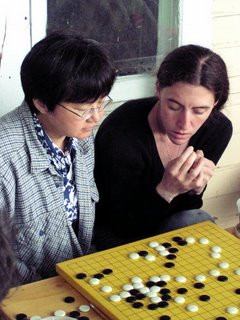
There's a story that goes along with it, which I believe Chunyan said comes from some historical occasion. There were these two regions at war and the army of one had fought its way into the region of the other, but had gone too deep too quickly. (I wouldn't be surprised if this is used as a Go proverb.) The invading army was surrounded and their opponents (if I have the story correct -- we were a bit confused about this) started singing a song from the homeland of the invaders to demoralize them.
The expression is used to mean that you're "facing hostility on all sides". I remember it by a misreading of the literal translation: there's country music on all sides.
四 = sì = four
面 = mìan = side
楚 = chǔ = country/area
歌 = gē = song
There's a story that goes along with it, which I believe Chunyan said comes from some historical occasion. There were these two regions at war and the army of one had fought its way into the region of the other, but had gone too deep too quickly. (I wouldn't be surprised if this is used as a Go proverb.) The invading army was surrounded and their opponents (if I have the story correct -- we were a bit confused about this) started singing a song from the homeland of the invaders to demoralize them.
The expression is used to mean that you're "facing hostility on all sides". I remember it by a misreading of the literal translation: there's country music on all sides.
Friday, September 21, 2007
LLL
No, this is not a post about the LLL algorithm, which a few of us might otherwise have been contemplating, or at least taking advantage of, when we instead went to see "Love's Labour's Lost" at the Globe last night.
I don't tend to stray far from my flat-to-office-and-back-again circuit these days, but the Globe is right on the Thames, halfway between work and home. Plus, as we stood in the yard through the whole play, the tickets were cheap.
The slapstick doesn't really do much for me and the plot is flimsy at best, but the banter is fun and the language lovely and the theatre itself a delightful place.
I don't tend to stray far from my flat-to-office-and-back-again circuit these days, but the Globe is right on the Thames, halfway between work and home. Plus, as we stood in the yard through the whole play, the tickets were cheap.
The slapstick doesn't really do much for me and the plot is flimsy at best, but the banter is fun and the language lovely and the theatre itself a delightful place.
Prin. But what was sent to you from fair Dumaine?
Kath. Madam, this glove.
Prin. Did he not send you twain?
Kath. Yes, madam; and moreover,
Some thousand verses of a faithful lover:
A huge translation of hypocrisy,
Vilely compil’d, profound simplicity.
Mar. This, and these pearls to me sent Longaville:
The letter is too long by half a mile.
Prin. I think no less. Dost thou not wish in heart
The chain were longer and the letter short?
Mar. Ay, or I would these hands might never part.
Prin. We are wise girls to mock our lovers so.
Ros. They are worse fools to purchase mocking so.
That same Berowne I’ll torture ere I go.
O that I knew he were but in by the week!
How I would make him fawn, and beg, and seek,
And wait the season, and observe the times,
And spend his prodigal wits in bootless rimes,
And shape his service wholly to my hests,
And make him proud to make me proud that jests!
So perttaunt-like would I o’ersway his state
That he should be my fool, and I his fate.
Prin. None are so surely caught, when they are catch’d,
As wit turn’d fool: folly, in wisdom hatch’d,
Hath wisdom’s warrant and the help of school
And wit’s own grace to grace a learned fool.
Ros. The blood of youth burns not with such excess
As gravity’s revolt to wantonness.
Mar. Folly in fools bears not so strong a note
As foolery in the wise, when wit doth dote;
Since all the power thereof it doth apply
To prove, by wit, worth in simplicity.
Sunday, September 16, 2007
LOTR

We arrived at the IMAX last night at 10:30 and left this morning at 9:15, one The Lord of the Rings trilogy viewing richer. I was afraid I wouldn't be able to make it all the way through, as they didn't even start until after my usual bedtime, but I can't sleep through a single scene of those movies. I still wish he had done The Hobbit, though it would have meant a few more hours at the theatre last night.
Walking home this morning in the crisp apple sunlight, with my eyes still full of tears and the soft Shire version of the soundtrack theme still floating through my head, I marvelled at how all the people on the street were clearly oblivious to the fact that the world had just been saved in an epic battle from an awful evil.
Subscribe to:
Posts (Atom)